Island of Barataria
Don QuixoteThe Island of Barataria is not described as a literal island but as a walled village of roughly a thousand inhabitants, one of the largest places belonging to the Duke. The Duke makes it the setting for Sancho Panza’s appointment as governor: the name may come from the village’s supposed name, Baratario, or from the joke through which the government is conferred. Barataria thus joins a concrete community to a deliberately theatrical political premise.
Setting and Name
The village gates, walls, church, and civic reception give Barataria the visible apparatus of a governed town. Its inhabitants welcome Sancho with ringing bells and public ceremony, and the municipality leads him first to the principal church to give thanks to God. The town’s keys are then presented with burlesque ritual, and Sancho is acknowledged as its perpetual governor. The formal setting makes the appointment look momentous even as the narrator identifies its comic foundation.
Sancho’s Installation
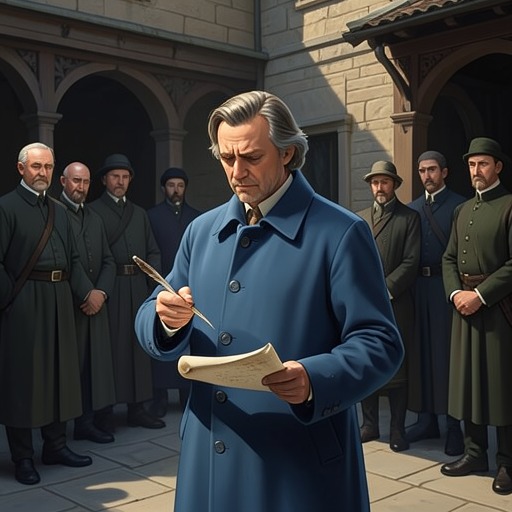
After the church ceremony, Sancho is brought to the judgment seat, where the Duke’s majordomo explains that a new governor must answer a difficult question so the people can judge his wit. The ceremony therefore turns political authority into a public test of judgment. Sancho, meanwhile, looks at an inscription on the wall but cannot read it; he asks what it says and is told that it records the day of his taking possession and wishes him many years in office. The contrast between the written markers of civic dignity and Sancho’s inability to read them sharpens the episode’s play between pageantry and practical competence.
The welcome also depends on appearances. Sancho’s costume, beard, and short, stout figure astonish both those unaware of the arrangement and many who know about it. The public spectacle does not simply disguise the joke; it makes the new governor’s body and status part of the spectacle, while the formal institutions around him lend the performance an air of legitimacy.
Government and Counsel
Barataria becomes more than a ceremonial backdrop when Sancho begins to issue measures for the community. In a letter addressed to the governor of the island, Don Quixote responds to reports of Sancho’s good sense with advice about the responsibilities of office. He counsels him to dress appropriately to its duties, treat the governed with civility, and ensure that food is plentiful, since hunger and high prices most trouble the poor. He also urges restraint in issuing proclamations and insists that laws must be enforced if they are to carry authority.
Sancho’s own ordinances translate that concern with everyday needs into specific rules. He prohibits provision sellers from profiteering, permits wine imports from any place if their origin is declared, and imposes severe penalties for watering wine or misrepresenting its name. He reduces the prices of shoes, boots, and stockings, particularly shoes, which he considers excessively expensive, and fixes servants’ wages in response to what he regards as their uncontrolled rise. His regulations also penalize lewd songs and require blind singers to provide evidence for the miracles they describe. Finally, he creates an officer to investigate whether people seeking alms are genuinely poor, while specifying that the office is not to harass them.
The Joke and the Town’s Legacy
The governorship remains part of a joke being carried out against Sancho. The majordomo and the other participants plan how to dismiss him, even as Sancho spends an afternoon drafting ordinances for what he believes is his island. That tension gives Barataria its narrative force: the rule is staged, but Sancho’s attention to prices, wages, public claims, and poverty is presented through concrete acts of government rather than ceremony alone.
The narrator says that many of Sancho’s rules are preserved there and called the constitutions of the great governor Sancho Panza. The claim gives the mock island a final civic afterlife within the story. Barataria is at once a Duke’s elaborate practical joke and the place where Sancho’s plain judgment takes recognizable legislative form.